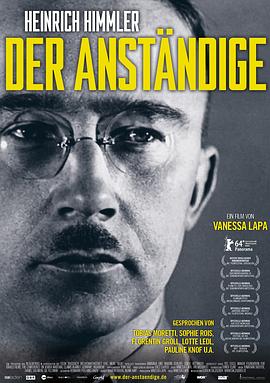
On 6 May 1945, soldiers of the 88th US Infantry Division occupied the Himmlers’ family home in Gmund on Lake Tegernsee where they discovered hundreds of private letters, documents, journals and photographs. The film makes use of these materials and copious archive footage to sketch the biography of SS commander Heinrich Himmler who committed suicide at the end of May 1945 by taking a cyanide capsule. How did this nationalistic lower-middle-class man become Hitler’s henchman responsible for developing and executing the strategies that led to the murder of millions of Jews, homosexuals, Communists and Romany people? Where did his ideology originate? How did he see himself and how was he perceived in private by his wife Margarete, his daughter Gudrun and his mistress Hedwig? How could the man who often referred to so-called German virtues such as order, decency and goodness also write home in the midst of the war and Holocaust: ‘I am well in spite of my heavy workload’? What was it that caused his daughter to say after a visit to Dachau concentration camp: ‘It was lovely …’ A film about the pretensions of a mass murderer and the repression of any sense of guilt. Berlinale 2014
简介: On 6 May 1945, soldiers of the 88th US Infantry Division occupied the Himmlers’ family home in Gmund on Lake Tegernsee where they discovered hundreds of private letters, documents, journals and photographs. The film makes use of these materials and copious archive footage to sketch the biography of SS commander Heinrich Himmler who committed suicide at the end of May 1945 by taking a cyanide capsule. How did this nationalistic lower-middle-class man become Hitler’s henchman responsible for developing and executing the strategies that led to the murder of millions of Jews, homosexuals, Communists and Romany people? Where did his ideology originate? How did he see himself and how was he perceived in private by his wife Margarete, his daughter Gudrun and his mistress Hedwig? How could the man who often referred to so-called German virtues such as order, decency and goodness also write home in the midst of the war and Holocaust: ‘I am well in spite of my heavy workload’? What was it that caused his daughter to say after a visit to Dachau concentration camp: ‘It was lovely …’ A film about the pretensions of a mass murderer and the repression of any sense of guilt. Berlinale 2014